(LLC vs S-Corp vs C-Corp vs Sole Proprietorship)
If you are planning how to start a business in the USA, one of the first and most important decisions you will face is choosing the right business structure. This choice is not just a formal step. It directly affects how much you pay in taxes, how well your personal assets are protected, how complicated your compliance requirements will be, and how easy it will be to grow or attract investors.
In the United States, there are several main types of business entities, and while they may seem similar at first glance, in practice they function very differently. Understanding how each structure works is essential before you move forward with company registration.

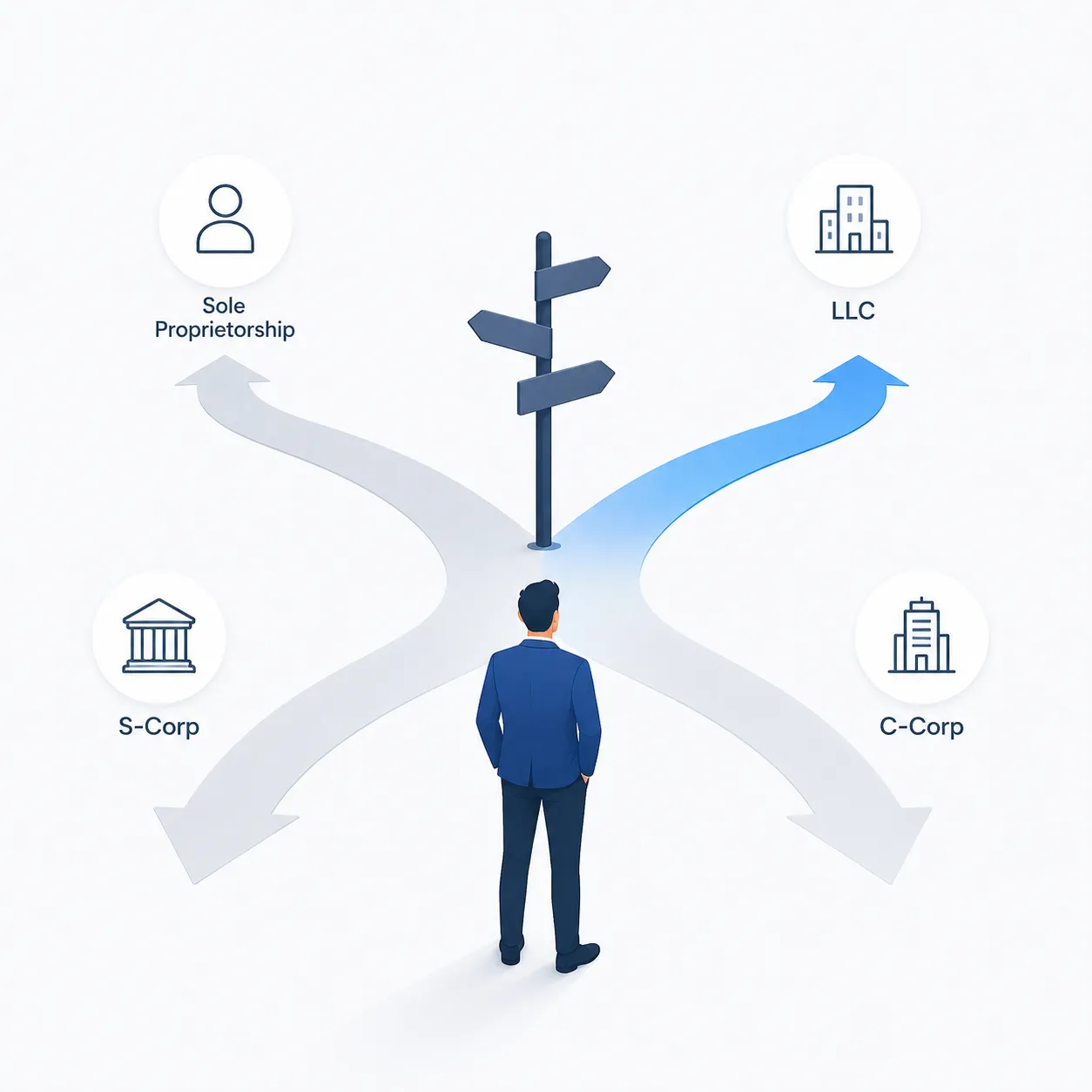
The simplest option is a sole proprietorship. This is the easiest and fastest way to start a business in the USA, requiring minimal paperwork and almost no upfront cost. Many freelancers and small business owners begin this way because income is reported directly on the owner’s personal tax return. However, this simplicity comes with a serious drawback. There is no liability protection, which means your personal assets are fully exposed if something goes wrong in the business. In addition, this structure offers limited opportunities for raising capital or scaling.
For most businesses, the next step is forming a Limited Liability Company, or LLC. This is one of the most popular business structures in the USA because it offers a balance between flexibility and protection. An LLC separates your personal and business assets, reducing your personal risk, while still allowing flexible taxation. By default, LLCs are treated as pass-through entities, but they can elect to be taxed as an S-Corp or even a C-Corp depending on the strategy. At the same time, LLCs have fewer formal requirements compared to corporations, which makes them easier to manage. The trade-off is higher formation costs and ongoing compliance compared to a sole proprietorship, and without proper tax planning, all income may be subject to self-employment tax.
An S Corporation, or S-Corp, is not a separate business entity but a tax election that can be applied to an LLC or corporation. It is often used by profitable businesses looking to reduce their tax burden. The main advantage is that it avoids traditional double taxation while allowing business owners to split income between salary and distributions, potentially reducing self-employment taxes. However, there are restrictions. An S-Corp is limited to 100 shareholders, all of whom must be U.S. citizens or residents, and it allows only one class of stock. This makes it less flexible for companies planning to raise investment.
For businesses focused on growth and investment, the C Corporation remains the standard structure. This is the model used by most large companies and startups planning to attract venture capital or go public. A C-Corp provides strong liability protection and makes it easier to issue shares and bring in investors. At the same time, it comes with more complex compliance requirements, including formal management structures, board meetings, and detailed reporting. It is also subject to double taxation, where the company pays corporate tax and shareholders pay tax on dividends.

Beyond the structure itself, another key decision is where to register your business. The choice of state can significantly impact taxes, reporting requirements, and long-term costs. States like Delaware, Wyoming, and Florida are often considered business-friendly, but the right choice depends on where your business actually operates. Registering in one state while conducting business in another typically requires foreign registration, which adds additional costs and compliance obligations.
From a tax perspective, the U.S. system combines federal and state taxation. The federal corporate tax rate is currently 21 percent, while state corporate taxes vary, averaging around 6.5 percent depending on the state. For pass-through entities such as LLCs and S-Corps, income is taxed at the owner level. This is why choosing the right structure from the beginning is not just a legal decision, but a financial strategy that can significantly affect your total tax liability.

In practice, there is no one-size-fits-all solution. The right structure depends on your business model, expected revenue, growth plans, and long-term goals. This is where professional guidance becomes important. Choosing incorrectly can lead to higher taxes, unnecessary compliance costs, and limitations on future growth.
Our role is to help businesses navigate these decisions and build the right foundation from the start. We provide full-service support for company registration in the USA, including selecting the appropriate business structure, choosing the best state for incorporation, and handling all formation documents, EIN registration, and licensing requirements. We also develop business plans for investor funding and visa applications such as E-2 and L-1, and provide ongoing bookkeeping, payroll, and tax compliance support.
With over 20 years of experience, we work with startups, small businesses, and international companies across all 50 states. Our approach combines accurate accounting, strict legal compliance, and strategic financial planning. The goal is not just to register a company, but to build a structure that supports long-term growth, minimizes taxes, and protects your business from unnecessary risks.